
From Experiments to Infrastructure
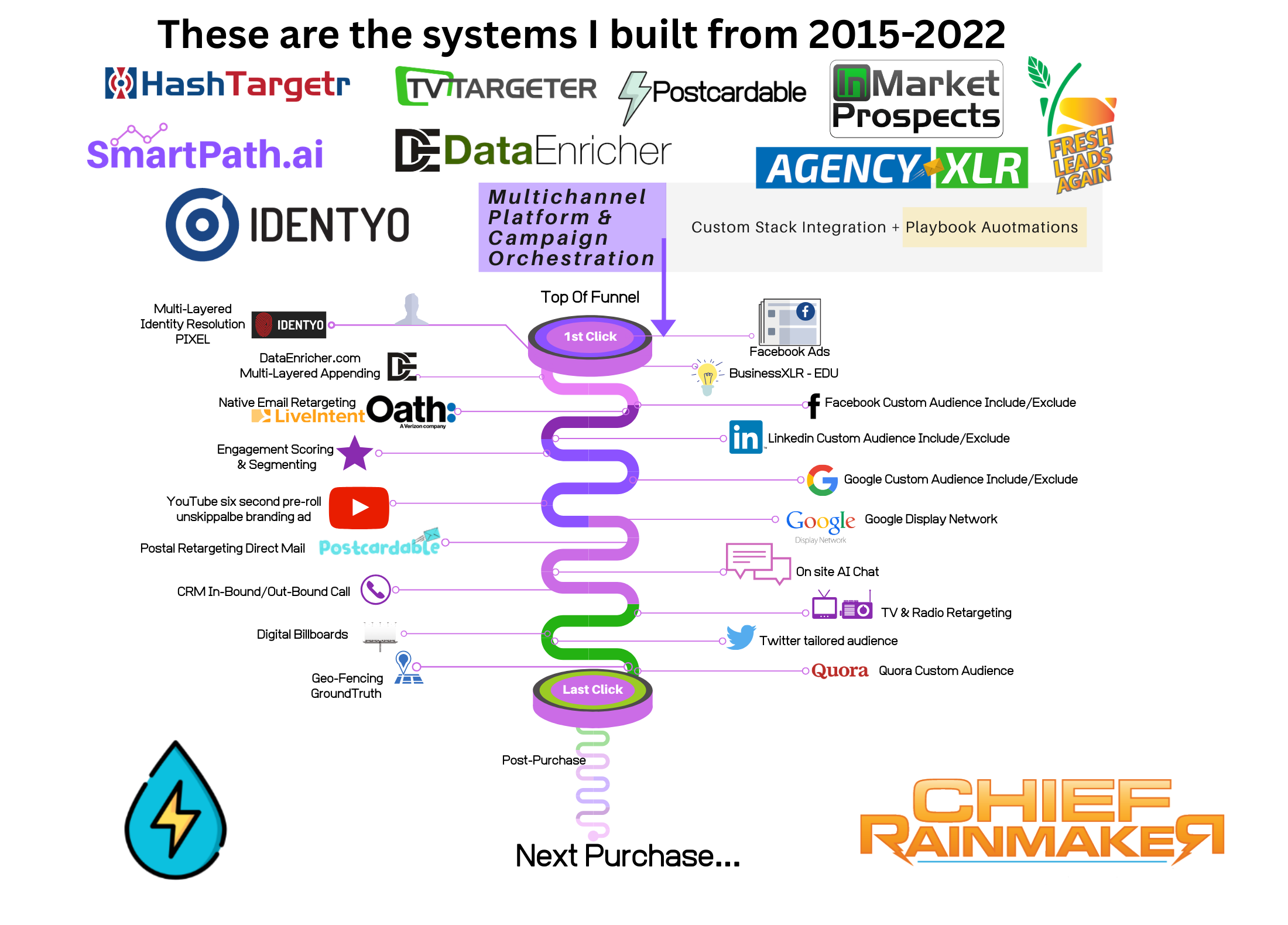
Between 2015 and 2022, eight marketing data systems were built, tested, and deployed under Profit Worldwide, Inc. / Chief Rainmaker — each one designed to answer the same core question: how do you reduce customer acquisition costs by making audiences smarter and activation faster?
No single system solved the whole problem. But each one revealed something the next one needed. Some generated revenue. Some failed economically despite working technically. All of them produced something more valuable than any individual platform: a deep, hands-on understanding of how data actually behaves under the pressure of live campaigns, real budgets, and unforgiving market feedback.
That education turned out to matter more than any of the systems themselves.
Because everything called "AI-powered marketing" today — audience intelligence, behavioral targeting, real-time personalization, identity resolution, predictive lead scoring — is built on the same principles being tested and rebuilt here years before the current AI wave arrived.
The tools are faster now. The logic hasn't changed.
These eight systems were the classroom. What came after was the application.
The Start
Five years before IDENTYO launched, the groundwork was already being laid. From 2015 to 2019, a series of experimental marketing data platforms were built and self-funded — each one designed to answer the same core question: how do you reduce customer acquisition costs by making audiences smarter and activation faster?
The Systems
Eight platforms. Eight experiments. HashTargetr. InMarket Prospects. AgencyXLR. Postcardable. Fresh Leads Again. DataEnricher. SmartPath.ai. TVTargeter. Each one explored a different piece of the audience and identity puzzle — from intent detection and identity resolution to data enrichment and real-time audience activation.
The Clients
These weren't lab experiments. The systems were deployed with 50+ digital agencies and enterprise brands, including ZEISS (Walmart Vision Centers), LendingTree, and Zebra — helping media buyers improve campaign performance through high-intent audience identification and activation across major ad platforms.
The Convergence
Every system built between 2015 and 2019 was pointing toward the same destination. IDENTYO was where they converged — a privacy-first identity technology funded in January 2020, built on everything that had been learned, tested, broken, and rebuilt across a decade of data experiments.
The Technology
A single website pixel. Real-time visitor identification, scoring, and segmentation. No personally identifiable information exposed to the advertiser. IDENTYO gave agencies and high-volume advertisers a cleaner, more measurable path to reducing the cost of clicks, leads, and customer acquisition.
The Cuban Lunch
In 2019, a lunch meeting with Mark Cuban shaped the final direction of the product. His feedback was direct: remove the complexity. Show one thing. The cost of acquisition, dropping. That clarity became the design principle behind everything IDENTYO delivered to the market.
The Launch
IDENTYO launched at the RampUp Conference in San Francisco in early March 2020 — one of the industry's premier identity and data events. Twelve days later, the world shut down. Launching into a global pandemic was not the plan. Gaining traction anyway was the result.
The Traction
Despite COVID disrupting the industry almost immediately after launch, IDENTYO found its footing. Agencies and high-volume advertisers recognized the value of privacy-first audience intelligence — and the platform continued to grow through one of the most difficult periods in recent marketing history.
The Lesson
The journey from HashMatcher to IDENTYO reinforced one conviction above everything else: great marketing technology isn't about more data. It's about turning the right data into measurable outcomes. More signal is not the goal. Better signal is.
The Through-Line
IDENTYO wasn't a sudden idea. It was the product of five years of deliberate experimentation, honest failure, and compounding learning. Every platform built before it contributed something. That process — build, test, learn, improve — is still the operating method behind everything that comes next.
The Recognition
By 2017, a pattern had become impossible to ignore. HashTargetr, InMarket Prospects, AgencyXLR, Postcardable, Fresh Leads Again, and DataEnricher had each solved one piece of the marketing data puzzle. But marketers didn't need more isolated tools. They needed a platform that connected everything together.
The Vision
That recognition led to SmartPath.ai — a unified campaign orchestration platform built to bring identity resolution, audience creation, data enrichment, and multi-channel activation into a single environment. Development ran from late 2017 through 2019.
The Real Problem
The technology worked. The handoff didn't. Clients could identify audiences and generate valuable insights — but their CRM workflows, automation systems, and media buying platforms were disconnected. Data got delivered. Action rarely followed. SmartPath.ai was built to close that gap by connecting the entire marketing stack and orchestrating campaigns automatically.
The Identity Layer
At the core of SmartPath.ai was an updated identity resolution pixel connected to multiple identity graphs simultaneously. The system could anonymously match 50–80% of U.S. website traffic to unified customer profiles — without exposing personally identifiable information. That unified identity layer became the foundation for everything else: segmentation, targeting, personalization, and activation.
The Orchestration
SmartPath.ai connected the silos. Facebook. Google Ads. LinkedIn. Email. On-site personalization. Geofencing. Digital billboards. Connected TV and OTT. Instead of running disconnected campaigns across disconnected platforms, the system coordinated messaging across every channel based on a single unified customer profile.
The 3% Strategy
At any given moment, roughly 3% of any market is actively ready to buy. The other 97% aren't — at least not today. SmartPath.ai focused on identifying that 3% through behavioral signals: time on site, pages viewed, frequency of visits, content engagement. Those high-intent visitors became the seed audiences fed into Facebook and Google's look-alike models. The platform wasn't trying to outsmart the algorithms. It was feeding them better data.
The Permanent Audience
Traditional retargeting pixels expire. The audience disappears when the window closes. SmartPath.ai introduced the concept of permanent and portable audiences — identity-resolved profiles that persisted across campaigns and channels. Instead of repeatedly buying access to the same audiences from ad platforms, marketers were building their own long-term identity graph. An owned asset, not a rented one.
The Honest ML Note
Despite the AI in the name, the underlying technology was machine learning regression models — not true artificial intelligence. Pattern recognition. Behavioral signal analysis. Models trained to identify which signals predicted high-intent prospects. The AI branding reflected where the industry was heading. The technology reflected what was actually built. Both things were true, and that distinction mattered.
The Cuban Lunch
In December 2019, a lunch meeting in Dallas with Mark Cuban — arranged through an investor contact — produced the most useful piece of product feedback in the platform's history. His read was direct: the platform was too complex. The market didn't want dozens of capabilities. It wanted one screen showing one number — the cost of acquisition, dropping. Simplify to the outcome. That note changed everything.
The Pivot
The Cuban feedback reframed the entire product direction. SmartPath.ai had powerful technology. But the market cares about results, not complexity. That insight — strip everything down to a single measurable outcome — became the design principle behind the next system. The one that launched at RampUp in March 2020. IDENTYO.
The Problem
A recurring challenge kept surfacing across every client engagement: incomplete data. A lead file with only an email address. A prospect record missing demographics. A CRM full of partial profiles that modern marketing systems couldn't do much with. The existing solutions were expensive, slow, or painful to integrate. So a better one got built.
The Origin
DataEnricher grew directly out of HashMatcher — the earlier platform that converted hashed email records into usable clear-text emails. The real opportunity turned out to be bigger than unlocking hashes. The market needed full-profile enrichment: taking incomplete records and expanding them into rich identity profiles with demographics, household data, geographic signals, and behavioral indicators.
The Platform
DataEnricher operated as a real-time data appending platform connected to roughly a dozen major data provider APIs simultaneously. Clients could upload a file, submit a single record, or connect directly through the API to enrich data automatically inside their own applications. Fast, flexible, and built to integrate cleanly into existing marketing stacks.
The Architecture Decision
DataEnricher was deliberately kept separate from the identity resolution pixel systems like HashTargetr. The two services never touched. That was an intentional architectural choice — keeping identity resolution and data enrichment isolated from each other to protect privacy and prevent PII from crossing platform boundaries. Privacy-first by design, not by compliance checklist.
The Business Model
Most of the systems built during this period required significant operational involvement. DataEnricher was different. It ran like a data vending machine — clients connect, data flows, revenue recurs. Almost entirely on autopilot. No sales team required. No manual fulfillment. Just a clean infrastructure product doing its job quietly in the background.
The Revenue
At peak, DataEnricher generated $40,000–$50,000 per month in recurring revenue. Not a moonshot. Not a unicorn story. A solid, reliable, infrastructure-style product that funded the experimentation happening around it and proved that simple automated systems solving real operational needs can be quietly, durably profitable.
The Four-Year Run
The platform ran successfully for four years. It served marketers, agencies, and software developers who needed a cost-effective, API-driven way to enrich their data workflows without dealing with the complexity or pricing of enterprise solutions. For four years, it delivered exactly what it promised.
The Shutdown
COVID changed the math. Client activity dropped sharply across multiple industries. The platform's underlying infrastructure costs — monthly licensing and usage fees across a dozen data provider APIs — stayed fixed while revenue volume fell. When those three elements fell out of balance, the system became unsustainable. After four years, it was shut down.
The Lesson
DataEnricher made something concrete that had been theoretical: self-funded technology platforms live at the intersection of product utility, infrastructure cost, and market demand. When all three stay in balance, a simple product can run profitably for years. When one shifts dramatically — as COVID shifted demand — even a stable platform can become unviable quickly. The business model matters as much as the technology.
The Through-Line
DataEnricher was another piece of the same puzzle being assembled across all these systems: how to identify, understand, and activate audiences more intelligently. Each platform contributed something. DataEnricher contributed the enrichment layer — the infrastructure that turned thin records into full profiles. That capability became a core component of what came next: SmartPath-AI.
My White Whale
Digital marketers were already retargeting visitors through display ads, mobile ads, and social platforms. But nobody had cracked postal retargeting at scale — triggering a physical postcard to a website visitor's mailbox based on identity resolution alone. That unsolved problem became the obsession. From 2017 to 2018, the chase was on.
The Concept
The idea was straightforward in theory. A visitor lands on a client's website. Identity resolution matches that visitor's email to a physical mailing address, no opt-in needed. A targeted postcard ships same day. Website visit to physical mailbox — automated, personalized, and tied to real browsing intent. Simple concept. Extraordinarily difficult execution.
The Canary File
To test identity accuracy honestly, a Canary File was built — approximately 2,000 verified records of friends, family, and known contacts whose correct information could be confirmed with absolute certainty. That file was run through the biggest, most respected data providers in the industry. The gold standard companies. The results: 30–40% accurate matches. On verified data. That number exposed an industry-wide problem that most marketers had no idea existed.
The Industry Problem
Several well-funded postal retargeting platforms were already in market making confident claims. Based on the Canary File results, those claims didn't hold up. Most solutions depended on single-database identity matching tied to NCOA records — a source widely assumed to be definitive. Testing showed it wasn't. Without additional verification layers, the probability of sending a postcard to the wrong person or an outdated address was far higher than the marketing suggested.
The Data Weakness
The deeper the testing went, the clearer a systemic flaw became: most identity databases had no reliable way to track recency. They couldn't tell you whether an email address was still someone's primary account or a relic from 2013. Stale email data produced stale postal matches. And stale postal matches meant postcards going to the wrong households at full campaign cost.
The Multi-Database Solution
The answer to single-database unreliability was multi-database consensus. Instead of trusting one source, the identity was run across five databases simultaneously. When at least three of five returned the same postal address, that address was treated as a confident candidate. Disagreement among the databases was treated as a signal to reject the match rather than guess.
The Mobile Verification Layer
Consensus across databases wasn't enough on its own. A final verification layer was added: Mobile Advertising IDs tied to the individual's devices, cross-referenced against GPS dwell-time data. If a person's mobile device consistently showed location signals matching the proposed postal address — meaning they actually spent significant time there — the match was confirmed. Website visitor to verified home address, with confidence.
The Technical Win
After months of testing, iteration, and validation, the technical problem was solved. A website visitor could be identified, matched to a physical mailing address with high confidence, and trigger a postal retargeting campaign tied directly to that visit. The system worked. The problem was what came next.
The Economic Reality
Solving the technical problem created a new one. The verification stack required to achieve real accuracy — multiple databases, identity graphs, mobile MAIDs, GPS dwell-time confirmation — made the system expensive to operate. Too expensive for the SMB market that represented the largest opportunity. The technical solution was real. The unit economics didn't work at the target price point.
The Lesson
Postcardable was one of the most educational experiments in the entire data systems journey. It proved that identity data accuracy across the industry is far worse than vendors claim, that single-database matching is a liability dressed up as a feature, and that solving a hard technical problem doesn't automatically produce a viable business. All three of those lessons shaped everything built afterward.
The Problem
Every business with a CRM has the same quiet problem. Thousands of leads — sometimes millions — that got labeled "dead" and stopped receiving attention. But most of those people aren't dead prospects. They're just not ready yet. The real question is: how do you know when they become ready again?
The Concept
Fresh Leads Again was built to answer that question. Clients uploaded their dormant lead databases. The system monitored behavioral and identity signals across data sources and flagged individuals who appeared to be back in market for the same product or service. When the signal fired, the client got an alert: this prospect is likely back in the buying cycle. Go now.
The Opportunity
The value proposition was straightforward. Instead of constantly spending budget chasing cold new leads, businesses could reconnect with people who had already raised their hand once — at the exact moment they were raising it again. Warmer lead. Lower acquisition cost. Higher conversion probability. The math worked on paper.
The Automotive Use Case
Car dealerships were the primary early test bed. The reason was obvious: automotive CRMs are full of past inquiries, test-drive leads, and prospects who came close but didn't buy. Over time those records get written off as dead data. Fresh Leads Again flagged the ones who appeared to be back in market — giving dealerships a chance to reconnect at exactly the right moment instead of finding out too late.
The Technology Worked
The system did what it was designed to do. Behavioral and identity signals were monitored across data sources. Return-to-market signals were identified. Alerts were delivered. The technical problem was solved. What happened next is where things got interesting.
The Operational Failure
The clients got the alert. They called once. Left a voicemail. Stopped. The follow-up process — which should have triggered a coordinated sequence across phone, email, SMS, retargeting ads, and direct mail — collapsed into a single unanswered voicemail and a shrug. The technology performed. The execution didn't.
The Hard Truth
A signal is not a sale. A signal is an opportunity with a short shelf life. Without a structured, multichannel follow-up system ready to activate the moment the alert fires, the signal just evaporates. The prospect moves on. The opportunity closes. And the business concludes — incorrectly — that the system didn't work.
The Real Lesson
Fresh Leads Again produced one of the clearest lessons across the entire data systems journey: data signals don't create outcomes. They create opportunities. Turning those opportunities into revenue requires a marketing execution system capable of acting on the signal quickly, consistently, and across multiple channels simultaneously. The data is only half the system.
The Pattern
This wasn't an isolated finding. The same gap kept appearing across every system built during this period. Technology would identify the right person at the right moment. Clients would receive the signal. And then the follow-up infrastructure — the part that actually converts opportunity into revenue — would fail to show up. Great data connected to weak execution produces weak results. Every time.
The Through-Line
Fresh Leads Again was a short chapter in the experimentation timeline. But it reinforced something that shaped every system built afterward: real-time signals, multichannel activation, and integrated marketing infrastructure aren't optional add-ons. They are the system. Data, timing, and execution have to work together — or none of them work at all.
The Extension
AgencyXLR grew out of a private bulk email and retargeting platform that had been built for a client. The experiment was simple: could that same infrastructure be extended to send emails to identified website visitors — even if those visitors had never formally opted into that specific website?
The Mechanism
The system worked in conjunction with the HashTargetr tracking pixel. When a visitor arrived on a client's website, the identity graph attempted to match that visitor to known data signals, including hashed email identities. If a match was found, the system could send a follow-up email on behalf of the advertiser — through a proxy layer that protected the individual's actual email address from ever reaching the client.
The Privacy Architecture
The advertiser never saw a clear-text email address. Ever. Emails went out through the system as a proxy — the brand communicated with the identified visitor, the visitor's PII stayed protected within the technical layer. The same principle that makes cross-device retargeting work without exposing phone numbers was applied here to email. Identity as infrastructure, not as exposed data.
The Cross-Device Analogy
Cross-device retargeting is already familiar: visit a website on desktop, see an ad on your phone an hour later. The advertiser doesn't have your phone number — a device graph made the connection. AgencyXLR attempted to apply that same logic to email. Website visit triggers identity match, identity match triggers a follow-up email, advertiser never touches the underlying PII. Same principle, different channel.
The Identity Graph Expansion
To support AgencyXLR, the identity graph infrastructure was expanded with multiple new data layers designed to improve match accuracy and audience profiling. That expansion exposed a problem that advertising platform activation had mostly avoided: email is messier than device IDs. People have work emails, personal emails, and a graveyard of old accounts they haven't checked since a previous decade.
The Email Problem
Multiple email addresses per person meant match accuracy was harder to guarantee than it had been in other channels. Maintaining clean, current, deliverable email data required constant hygiene — verification services, suppression layers, bounce management, recency checks. Each additional layer added operational cost and complexity that hadn't been factored into the original model.
The Honest Result
After extensive testing, the verdict was clear: more sizzle than steak. Campaign lift was inconsistent. The operational cost of maintaining accurate identity data and email verification eroded the economic advantage the system was supposed to create. The concept was compelling. The execution economics didn't support it at the scale needed to make it viable.
The Context
At the time, almost nobody was experimenting with this type of system — which meant there were no benchmarks, no established best practices, and no roadmap to follow. Every lesson came from live testing. That made the failures expensive but also made the learnings genuinely original. The insights didn't come from reading about what others had done. They came from building something nobody had built before.
The Larger Lesson
AgencyXLR clarified something that kept emerging across every system: identity accuracy, data recency, and cross-channel activation are all harder than they appear from the outside — and the gap between a compelling concept and a viable product is almost always filled with operational complexity that isn't visible until you're inside it.
The Direction It Pointed
AgencyXLR pushed the architectural thinking toward something cleaner: real-time audience creation, cross-channel activation, privacy-first identity systems, and minimal reliance on PII at every layer. Not because the email experiment failed, but because the failure made the right direction clearer. The future wasn't in finding new ways to touch PII. It was in building systems that didn't need to.

The Gap
HashTargetr proved that identifying high-intent audiences dramatically improved advertising performance. But it had a built-in limitation: it only worked with people who had already visited a client's website. The bigger opportunity was identifying in-market buyers before they ever showed up. That question drove the next system.
The Concept
InMarket Prospects used behavioral signals from across the broader internet — not just first-party website traffic. By partnering with a company operating a Demand-Side Platform for programmatic advertising, it became possible to identify consumers actively browsing specific types of content on other websites and build targetable audience segments around them.
The PSA Strategy
Competitive ad placements on high-intent pages — mortgage comparison sites, eyewear shopping pages, insurance marketplaces — came with premium CPM costs and frequent approval rejections. The workaround was unexpected: run PSA ads instead. Anti-drug messages. Public awareness campaigns. Neutral content that publishers almost always accepted at floor-level CPM rates.
The Real Product
The PSA ads weren't the product. The data exhaust they generated was. DSP platforms receive attribution and reporting data that advertisers normally never see — exact page URLs where ads were served, keyword signals from search queries, contextual page information. That data revealed which consumers were actively browsing mortgage pages, eyewear shopping pages, insurance comparisons, and dozens of other high-intent categories.
The Identity Layer
Once those audiences were identified through programmatic signals, identity resolution was applied to match behavioral data to hashed email identities. The result was targetable audience segments — deployable into Facebook, Google, and programmatic ad exchanges as seed data for look-alike audience models. High-intent audiences, built from third-party behavioral signals, activated across every major ad platform.
The ZEISS Campaign
ZEISS — the lens manufacturer operating eyewear centers inside Walmart stores — needed to reach Walmart.com eyewear shoppers specifically, distinguishing them from people browsing independent eyewear brands. InMarket Prospects identified audiences browsing Walmart's eyewear pages and built targeted segments around them. ZEISS presented the strategy directly to Walmart, which approved a co-op funded campaign.
The Enterprise Validation
The ZEISS campaign ran for six months. Performance was strong enough that Walmart renewed the contract for a second year. It ran until Walmart brought its advertising inventory in-house and moved away from Google's external ad ecosystem. An enterprise brand, a major retailer, an 18-month campaign — real validation of a genuinely novel approach to audience identification.
The Scalability Problem
The system worked. Scaling it didn't. Every campaign required AdOps teams to manually extract data, segment audiences, score intent signals, export lists, and upload them into advertising platforms. Each step was a handoff. Each handoff was a delay. And in algorithmic advertising, delay is expensive — the faster high-quality seed audiences can be created and updated, the better platform algorithms perform.
The Key Insight
The manual process exposed something more important than an operational inconvenience. Audience identification, scoring, and segmentation needed to happen in real time to fully unlock the power of algorithmic platforms like Facebook and Google. The quality of the seed data mattered. But so did the speed at which it could be refreshed. Static audiences fed into dynamic algorithms produce diminishing returns.
The Direction
InMarket Prospects shifted the focus from discovering audiences to activating them faster. The next generation of systems wouldn't just find in-market buyers — they would identify, score, segment, and deploy them in real time, automatically, without manual AdOps involvement. That realization became the architectural foundation for everything built next.
The Shift
Around 2015, a change became visible in digital advertising. Marketing was moving away from simply buying traffic and toward understanding who the audience actually was before the campaign began. That shift pointed toward a specific problem worth solving — and a first experiment worth building.
HashMatcher
The first system was simple by design. HashMatcher let agencies and data teams upload hashed email files — encrypted with MD5, SHA-1, or SHA-256 — and receive matched clear-text emails in return. It launched with a 50% match rate. Within six months, through testing and data refinement, that pushed to 87–95% consistently. Without a dollar of marketing, it grew to $10,000–$15,000 in monthly recurring revenue. The demand was already there. It just needed a tool that worked.
The Bigger Idea
HashMatcher solved a real problem. But it was a static solution — processing data files after the fact. The bigger opportunity was identifying high-intent audiences in real time, while they were actively on a website, and building targetable profiles around them before the session ended. That idea became HashTargetr.
The Pixel
HashTargetr placed a small tracking pixel on a client's website. When visitors arrived, the system analyzed behavioral signals in real time: time on site, pages viewed, repeat visits, specific products or categories browsed. Those signals were used to identify high-intent users as they engaged — not after they left, not days later. In the moment.
The Identity Layer
Using identity resolution techniques, HashTargetr matched a portion of those behavioral signals to hashed email identities — building real-time data profiles around individual visitors without ever exposing personally identifiable information to the client. The advertiser never saw a clear-text email address. They received an audience segment they could activate. Privacy-first by architecture.
The Match Rate
At launch, the system could identify 35–50% of website visitors. That number improved steadily as the identity graph expanded and the behavioral signal models were refined through live campaign testing. Every campaign produced data. Every data point improved the next match. The system got smarter the more it ran.
The Performance Impact
The audience segments HashTargetr produced were fed into Facebook and Google's look-alike audience models as seed data. The results were consistent and significant: advertisers using high-intent, identity-resolved seed audiences reduced customer acquisition costs by 3x or more compared to campaigns built on broad demographic targeting. The algorithm wasn't different. The input was. Better data in, dramatically better output.
The Insight That Held
Extensive testing across different seed audiences, behavioral signals, and segmentation strategies kept producing the same finding: the better the seed data, the better the algorithmic performance. Every variation confirmed the same principle. It wasn't a hypothesis anymore. It was a repeatable, measurable result that shaped every system built afterward.
The Automation Wall
HashTargetr exposed a limitation that would drive the next several years of development. Creating audience segments, exporting hashed data, uploading audiences into ad platforms, and managing segmentation updates all required manual steps across disconnected systems. For the approach to truly scale, the entire process needed to be automated and operating in real time. The technology to make that possible didn't exist yet. That gap became the roadmap.
The Through-Line
HashTargetr proved the core thesis: identifying high-intent audiences dramatically improves advertising performance. It also proved that proving something and scaling it are two different problems. The manual processes, the activation gaps, the need for real-time automation — every limitation pointed directly at the next system. And the system after that. And the one after that. This was where the journey started.