
Get Identity Resolution Right for a Seamless Customer Journey
In the vast expanse of the internet, connecting with your audience can feel like finding a needle in a haystack. Identity resolution is key to standing out. It links different data to show a complete view of your customers, helping create personalized customer journeys.
Understanding consumer behavior is crucial for businesses. Recent studies show that 76% of businesses see identity resolution as vital for better customer experiences and targeting marketing. Yet, 92% have trouble connecting consumer identities across digital platforms and devices.
Keeping track of customer identities in real-time and across domains is crucial. 88% of businesses say seeing the full picture of each customer journey is essential. However, there are privacy and regulatory challenges, and 63% of businesses worry about the impact on their strategies.
First-party data is a game-changer for maintaining consumer trust and compliance with privacy. 85% of businesses see its importance. Using identity stitching can improve visitor engagement and conversion rates by 40%.
Identity resolution is more than an option; it’s a must. 81% of businesses in today's market say it's essential for success. Personalized experiences based on stitched identities lead to a 55% customer loyalty and growth boost.
Key Takeaways
Identity resolution is essential for effective customer data management.
76% of businesses acknowledge its critical role in enhancing consumer experience.
92% of businesses struggle with multichannel identity connections.
First-party data is essential for maintaining trust and compliance.
Identity stitching significantly boosts engagement and conversion rates.
What is Identity Resolution?
Today, the digital world is complex. It's hard to track how consumers interact with different platforms. Identity resolution fixes this by linking consumer info from multiple sources. This way, a complete picture of each customer is formed across all platforms.
Definition of Identity Resolution
The identity resolution definition joins different identifiers, like emails, device IDs, and social accounts, to one person. This is key to knowing who your customers are. It lets you see what each person does across channels accurately. Proper identity resolution is required, and many marketers find it tough to handle data from different channels without it, says the IAB.
The Importance of Identity Resolution in Today’s Digital Landscape
Identity resolution is vital for today's marketing. It helps make marketing more personal and effective. With better personalization, businesses can see big boosts. Revenue, customer retention, and marketing efficiency can all get better. Studies show personalization can increase efficiency by 10-20%, and revenue by up to 30%.
This is especially important today, when we market across many platforms. With identity resolution, you can ensure messages are relevant and consistent, creating a smooth and enjoyable journey for your customers.
It also helps meet privacy laws like the CCPA and GDPR. By using identity resolution, you lower the risk of privacy issues and keep data accurate. This leads to better customer interactions and more precise marketing data.
Benefits of Identity Resolution
Implementing identity resolution can greatly change your business. It offers a full view of your customers and boosts marketing efforts. Let's explore its main benefits here.
Getting the identity right from the start is the key to mapping the entire customer journey.
Enhanced Customer Understanding
With identity resolution, companies get a “360-degree view” of their customers. This helps in improving how businesses interact across all points. It involves collecting and organizing data from many sources to create precise customer profiles. This leads to insights into customer behavior. Such insights are key to making better decisions and strategies. It's vital for any company aiming for success through data use.
Personalized Customer Experience
Identity resolution is key for creating personal experiences. It lets businesses use customer data to match communications and deals with each person's likes. Today, most consumers expect customized interactions. Plus, it’s done safely. A good personalization approach improves engagement and makes customers happier.
Improved Marketing Strategies
Better understanding and personal experiences boost marketing efforts a lot. Using insights from identity resolution helps in targeting specific groups better. This focus raises the chances of turning leads into sales. It also makes marketing investments more profitable. For example, Data Clymer saw a 15% reduction in errors. The Giants cut their insight time by half. This technology can greatly improve how well your marketing works. It's about using sound data to make your business grow and thrive.
Identity Resolution Platforms
In today's fast-paced digital world, identity resolution platforms are key for marketers. They help to piece together a customer's journey seamlessly. By merging consumer data in secure and expandable ways, these platforms enable a consistent review of customers' actions across all platforms.
Features of Identity Resolution Platforms
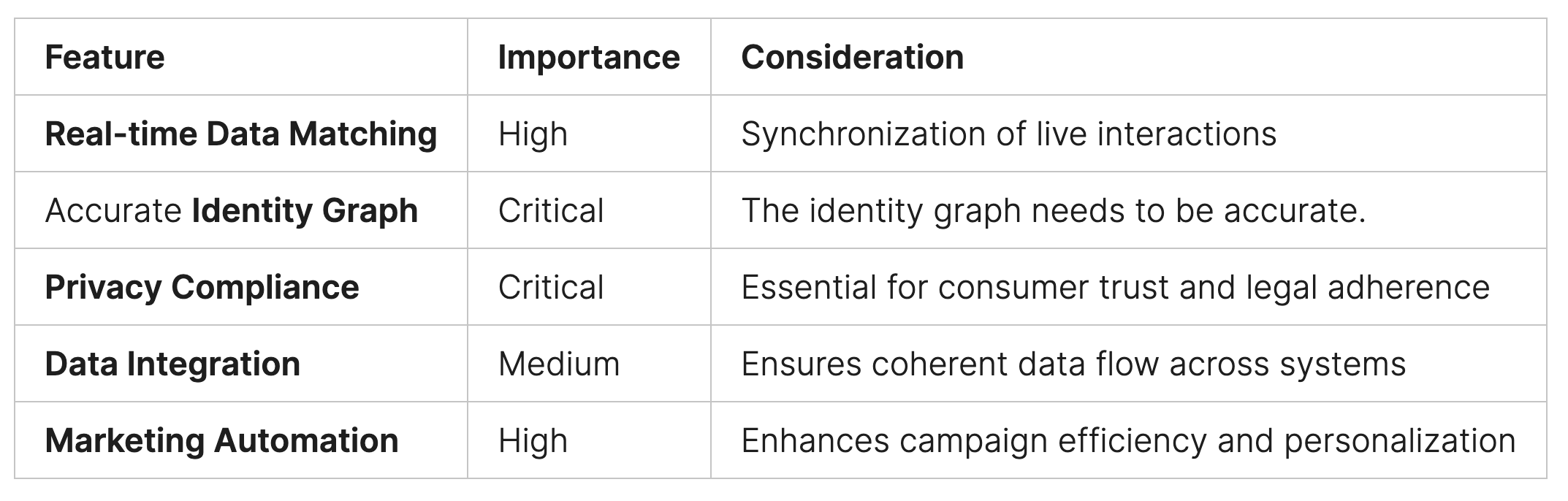
When looking at different identity resolution providers, companies need to check for specific characteristics:
Real-time data matching: Makes sure consumer data is immediately linked up.
Proprietary identity graphs: Joins different ID points to make whole customer profiles.
Privacy compliance: Meets rules like CCPA and GDPR, helping keep customer trust.
Robust data integration: Works smoothly with your current marketing tools and outside systems.
How to Choose the Right Identity Resolution Platform
Finding the best identity resolution platform for your business means looking at certain things:
How accurate is the data according to third-party auditors like TruthSet?
Privacy and Compliance: With laws like CCPA, platforms must closely follow privacy rules.
Scalability: The Cisco Internet Report shows we'll have more device connections than people. Your platform needs to grow with this.
Marketing Automation: Check that the platform can support marketing automation for better processes.
API Integration: The ability to link with other systems is vital for a complete view of customer info.
Is it affordable and within your budget?
Believe it or not, some brand name data companies have a large percentage of inaccurate data. You want to avoid the garbage-in-garbage-out scenario.
Understanding Identity Graphs
An identity graph is a must in today's marketing. It's a big database that combines all the known customer details, such as email addresses, CRM IDs, and device IDs, to create detailed customer records.

Businesses use the identity graph to connect data and match up different identifiers quickly. This helps fill the common data gaps when information is stuck in different company systems, such as CRM, ERP, DMP, CMS, and others.
The Adobe Experience Platform helps a lot with sorting out customer identities. It offers powerful tools for ensuring the information is accurate and complete, including identity collection and a special Identity Service API.
Getting a clear view of customers in real time is key. This is because people use several devices a day, and most new online visitors switch devices and web browsers. Without a great identity graph, keeping up with customer data is tough.
Identity graphs do more than just link data to one person. They also help with things like:
personalized customer service
cross-device attribution
personalized in-app experiences
effective promotions
This makes marketing smarter and more effective. It reduces wasted efforts and improves the effectiveness of reaching customers on every platform.
Finally, having a top-notch identity graph is vital for companies that want to connect better with their customers. It's crucial for intelligent marketing and ensuring your data is used well.
Real-Time Data Matching
Real-time data matching is key for companies wanting to compete. This tool lets firms quickly spot users online. They can then personalize the user's experience right on time. Imagine matching identity data from many countries at once. That's what makes this tool great.
It's great for battling fraud and compliance costs. This is true for many business areas.
Importance of Real-Time Data Matching
Real-time data helps businesses run smoother and keeps customers happy. It links customer info quickly, painting a clear picture. This is vital for making intelligent choices and improving how products are sold. The banking and retail fields find this very helpful. It helps them spot risks and know their clients better.
Challenges in Implementing Real-Time Data
Even though real-time data is valuable, it faces hurdles. The process involves syncing up data, ensuring it's accurate, and handling many touches simultaneously. Companies must also ensure their systems are up to snuff for quick data handling.
Overcoming these obstacles is crucial for gleaning all the benefits of real-time data matching. It sets businesses up for success with their data in the future.
Overcoming Multichannel Environment Challenges
Today, people are using more smart devices than ever, making it difficult for businesses to collect data. In 2024, there will be three devices connected to the internet for every person on the planet. Businesses need a strong plan to keep track of customer interactions.
Consumer journey mapping is critical to tackling these issues. This method helps businesses understand how customers use different devices. Google will stop supporting third-party cookies by the end of 2024, making using first-party data to track customer habits very important.
It is also crucial to be able to identify customers on different devices. Since only a small percentage of iPhone users share their data, businesses need new ways to collect and use information. Forrester finds that many top executives believe their systems are better than they are. They stress the need to improve these methods constantly.

Businesses have to follow laws like GDPR and CCPA to handle customer data. They aim to be ethical while understanding customers better. This lets them offer a more personalized service without invading privacy.
Dealing with these challenges needs a detailed plan. A good identity resolution strategy helps companies understand how customers interact with their brand. It ensures that each customer contact point is properly recorded and fits into the customer journey.
Security and Privacy in Identity Resolution
Businesses must keep their security strong and follow privacy rules when handling identities. The rules, like CCPA and GDPR, make it important to protect data. They also ensure companies handle customer data well, respecting privacy.
Privacy Compliance with CCPA and GDPR
CCPA and GDPR are big laws protecting customer data. They regulate how businesses can use data. These laws give consumers more control, like the right to see or remove their information.
Data Security Best Practices
Keeping customer data safe is key. Businesses must encrypt info, control who gets it, and regularly check security. It's also good to mainly use your data and less from others. This keeps things safer and follows the rules.
A solid security plan helps meet privacy rules while using customer data smartly. Businesses can make customers happy by providing personal and safe services. It also makes them stand out in a world that values privacy more.
Deterministic vs. Probabilistic Matching
Knowing the difference between deterministic matching and probabilistic algorithms is key to sorting identities well. Each method has its own unique touches and limits, shaping how precise your data accuracy might be. They also clearly affect your overall plan.
Deterministic matching looks for exact matches, such as email addresses and job titles. It usually gets 70–80% right. It's known for being exact, so you feel sure about the matches you find. Yet, it can hit a roadblock if some info is missing or if there are typos.
On the other hand, probabilistic algorithmscheck a wider set of data using models. This includes things like IP addresses, operating systems, or where users are at the moment. Probabilistic algorithms can make your database richer and help with more significant marketing pushes. However, they rely on some guessing, which decreases their pinpoint accuracy. They also struggle with telling apart certain actions, like just browsing or actually buying something.
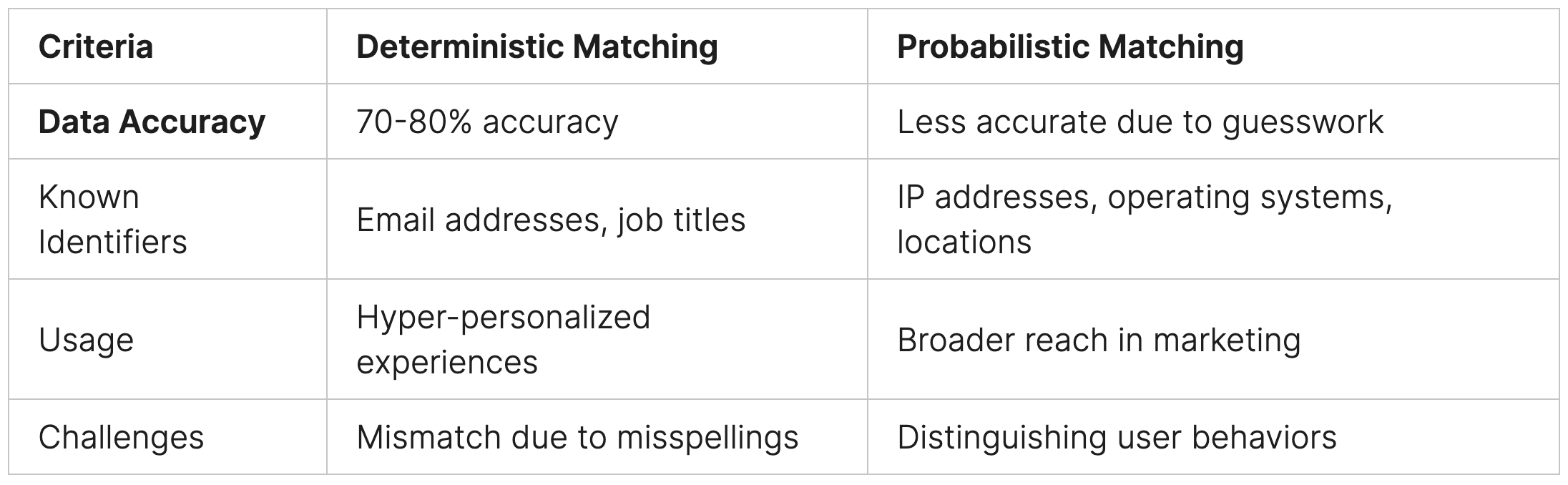
Using a mix of both deterministic matching and probabilistic algorithms is usually the smart way. This way, you take advantage of what each does best. Think about your project's special needs, the data you have, and how much you value privacy. Then, you can choose the right identity-matching mix for your work.
Implementing Identity Resolution in Your Business
A crucial part of identity resolution is a strong customer data strategy. It all starts with creating an identity graph. This graph joins various customer details, giving a complete picture of them.
Success in identity resolution depends on specific vital steps. First, you need to gather and clean up your customer data. This means fixing inconsistencies and ensuring you have the correct information for each customer.
Then, it's essential to connect these customer details. This improves your marketing and helps avoid messages that don't fit the customer. It also makes it easier to give customers personal, relevant experiences.
Incorporating People-based data into your identity resolution strategy adds another layer of depth. People-based data focuses on identifying and understanding individuals across various devices and platforms. This allows for even more precise and personalized marketing efforts, ensuring that your messages reach the right person at the right time, regardless of their device.
Implementing identity resolution also helps you follow privacy rules and makes reporting easier. Organizing customer data well allows you to follow rules such as CCPA and GDPR. This also means your insights and reports will be more accurate.
When choosing identity resolution, consider deterministic and probabilistic matching. Deterministic matching is very accurate, with exact matches like email addresses. Meanwhile, probabilistic matching uses patterns to connect data, offering a more comprehensive look.
The best outcome of identity resolution is a better customer experience, which can lead to more loyal customers and more sales. A good approach includes using cloud data storage to keep data accurate.
A great identity resolution strategy gives you clear views of your customers. With this insight, your decisions, operations, and personalizations will be more spot-on, giving your business an edge in a competitive market.
Conclusion
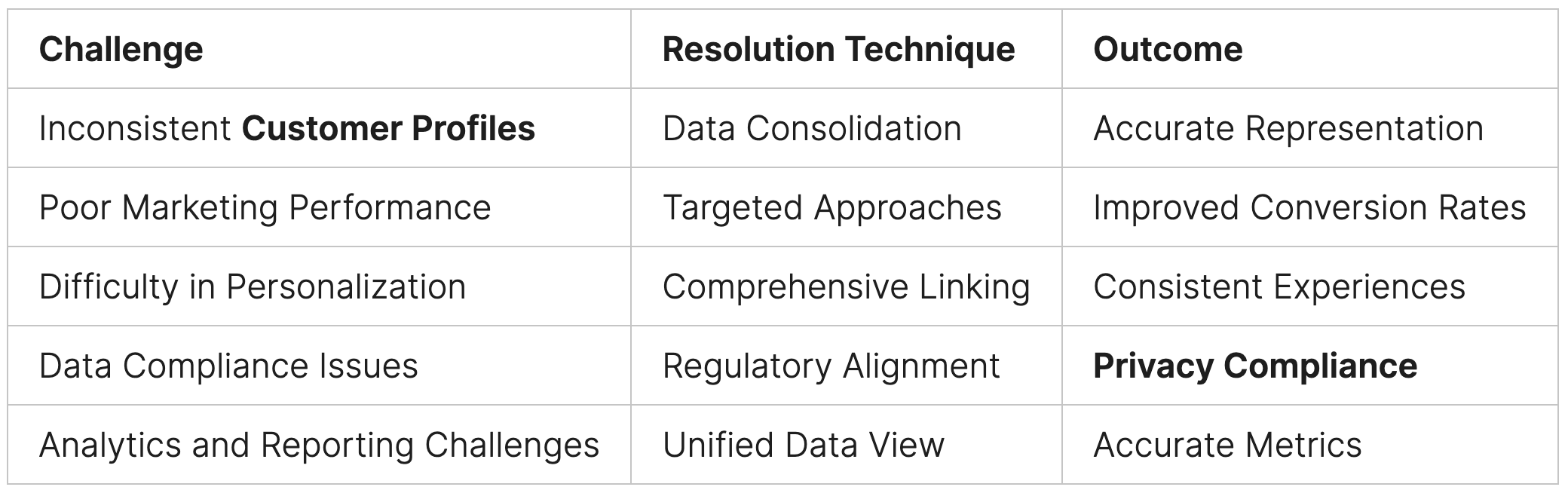
Identity resolution is a key strategy for companies wanting to improve their customer engagement. It lets companies fix problems in customer data and see a clear picture of each customer. This way, they can stop making duplicate entries and do better in their marketing. This leads to more sales and fewer customers leaving right away.
Getting identity resolution right means customers have a smooth experience wherever they interact with the company. Messages are customized to match what each customer likes. This makes a big positive impact when companies talk to their customers. Also, it helps companies follow rules about customer privacy and data use better.
Having unified and top-notch information about customers helps companies in many ways. They can manage risks well, follow the law, and operate more smoothly. Whether they're fighting financial crimes or making detailed customer profiles, this is useful. Identity resolution helps companies know their customers and expand their business over time.
FAQ
Identity resolution integrates the different ways we identify consumers. It creates a single profile for each customer. This helps businesses know what consumers like and do, improving their marketing.
It is key in the digital world because it keeps customer interactions smooth. This makes customers happy and loyal. Businesses can offer personalized services across all platforms.
It combines data from many sources to better understand customers. With this data, companies can meet individual needs and offer services that match each customer's wants.
Look for accurate data, real-time matching, and strong data security. Check if it follows privacy rules. Also, see if it can work well with your data and offers good analysis tools.
Pick one that can handle a lot of data. It should match your current tech and budget. Make sure it’s privacy-friendly. Also, consider the help the provider offers.
It’s a database connecting all the info we have about a consumer. This connection helps in sending just the right messages. It makes understanding and marketing to the customer better.
It's crucial for immediate, right-on-time customer interactions. It makes the customer feel understood, which is key to a great customer experience.
Challenges include data not being up-to-date, the complexity of pulling data from many places, and ensuring data accuracy and speed. These issues need to be addressed for this to work well.
They need a strong strategy to integrate all customer touchpoints. This will allow them to get a full picture of the customer journey and lead to more accurate and engaging interactions.
Being privacy compliant means following laws like CCPA and GDPR. Using customer data safely is a must. It’s about focusing on customer's data rights and securing their info.
Deterministic matching uses exact matches, making it very precise. Probabilistic matching makes guesses using models. It’s not as sure but covers more, based on likelihood. Look-a-Like audiences are probabilistic. Customer data is deterministic.
Start by creating an identity graph. Then, clean and link your customer data. This gives you a full view of the customer. It makes your marketing and data use better and follows privacy laws.
If you need help setting up your own identity graph, contact me. I'm happy to help. I've been building identity graphs for over ten years.
Source Links
https://www.celebrus.com/blogs/cdp/what-the-heck-is-identity-stitching-unified-consumer-journey
https://www.getcensus.com/blog/what-is-identity-resolution
https://www.mparticle.com/blog/what-is-identity-resolution/
https://hightouch.com/blog/what-is-identity-resolution
https://www.expressanalytics.com/blog/benefits-of-identity-resolution-in-customer-engagement/
https://dataclymer.com/blog/identity-resolution-benefits/
https://www.reltio.com/blogs/benefits-of-identity-resolution/
https://martech.org/what-is-identity-resolution-and-how-are-platforms-adapting-to-privacy-changes/
https://martech.org/what-can-identity-resolution-platforms-do/
https://www.richpanel.com/blog/what-is-an-identity-graph
https://lbdigitaldata.com/blog/identity-graphs-and-identity-resolution-explained
https://www.informatica.com/resources/articles/what-is-identity-resolution.html
https://www.growthloop.com/university/article/identity-resolution
https://www.growthloop.com/university/article/deterministic-vs-probabilistic-matching

For over 30 years, Gil has earned the esteemed moniker of "The Chief Rainmaker" due to his renowned expertise as a Customer Acquisition Specialist. "Harnessing data is the key." Leverage data-driven technology to turn your advertising & marketing expenses into lifetime valued ASSETS.
Follow Me
ABOUT GIL ORTEGA
For over 30 years, Gil has earned the esteemed moniker of "The Chief Rainmaker" due to his renowned expertise as a Customer Acquisition Specialist.
